Data breach statistics by year: 2026 forecast shows rising risks

Key cyber incident statistics of 2026:
- 3,322 data compromises were recorded in 2025, the highest ever tracked.
- Cyber incidents have increased by 79% over the past five years.
- 165.8 million victims were affected by breaches in 2025.
- Cyberattacks caused nearly 78% of confirmed data compromises.
- The financial services sector experienced 739 breaches, the most of any industry.
Cybersecurity has graduated from a back-office IT concern to one of the decade's most significant economic risks. As we move into 2026, the digital battlefield has evolved into a high-speed AI arms race that enables increasingly sophisticated cyberattacks, threatening the core pillars of modern society, such as energy grids, healthcare providers, and the global financial supply chain.
The scale of this shift is staggering. According to the Identity Theft Resource Center (ITRC), 2025 set a grim new benchmark with 3,322 recorded data compromises, a record-shattering 79% increase in just five years. Even though organizations have spent billions on security, attackers now use advanced AI and social engineering to bypass traditional defenses.
The financial impact is just as dramatic. IBM’s latest research shows the average global cost of a breach is about $4.88 million, but in the United States, it has now passed $10 million for the first time. This article will review key cyber incident statistics for 2025 and 2026, explain why some industries are targeted more than others, and discuss what the "Great Decoupling" of security costs could mean for your organization’s future risks.
🏷️ LIMITED OFFER: TotalAV deal! Get TotalAV, now 80% OFF 🏷️
How cyber incidents evolved (2015–2026)
Let's go back to 2015, when for most of us, the cloud was just a new place to store vacation photos, and a cyber incident usually meant a slow laptop or an annoying pop-up. Fast forward to 2026, and the digital landscape has transformed into a high-stakes battlefield. Today’s attacks aren't just digital nuisances; they are systemic threats that paralyze hospital networks, drain bank accounts, and disrupt power grids that keep our homes warm.
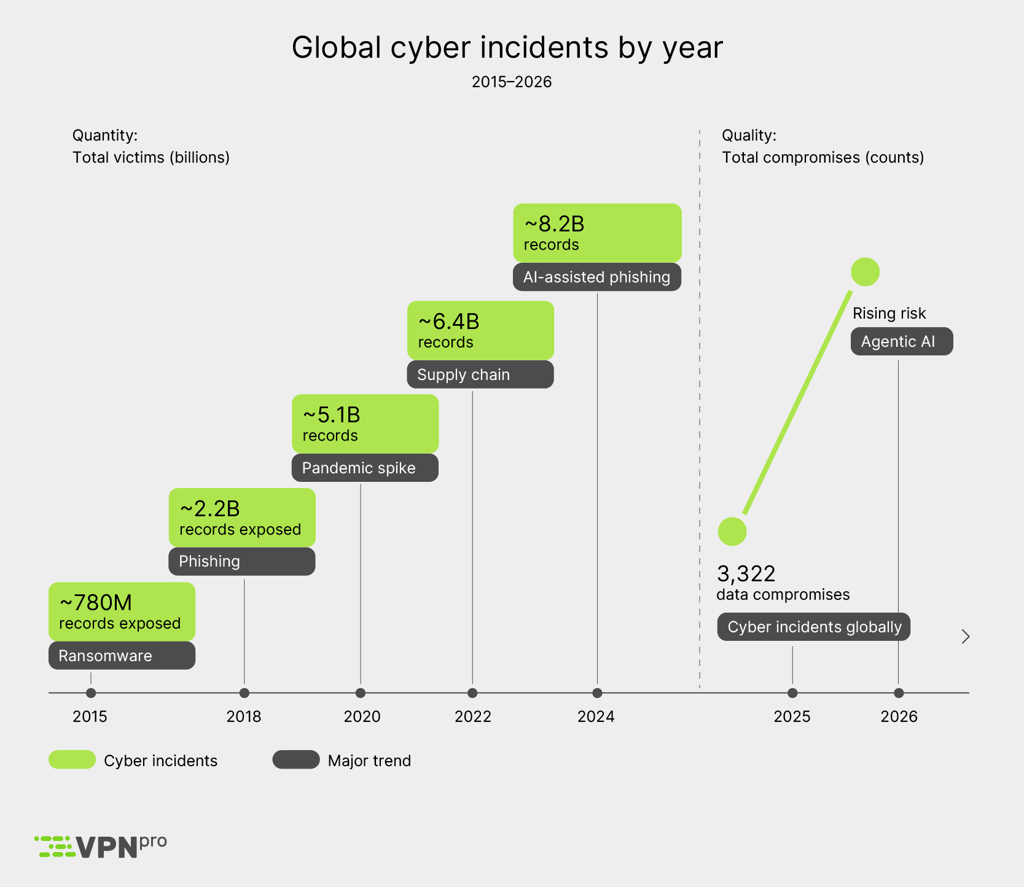
We have moved from the era of the lone hacker into the sophisticated age of Cybercrime-as-a-Service (CaaS). This shift is something we all feel daily, whether it’s the frustration of constant multi-factor authentication codes or the news of yet another retail giant leaking customer data. However, to understand where we are going in 2026, we have to look at the steps that brought us here. Below, I’ve collected data from the most significant global reports to show how cyber incidents evolved from simple scams into a multi-trillion-dollar global crisis:
| Year | Cyber incidents | Major trend |
| 2015 | ~780M records exposed | Early ransomware. The first time hackers successfully locked user files for a fee. |
| 2018 | ~2.2B records exposed | The phishing pivot. Attacks have shifted to Business Email Compromise (BEC). Hackers stopped sending spam and started impersonating bosses and banks. |
| 2020 | ~5.1B records | The pandemic spike. A global shift to remote work has opened millions of insecure home Wi-Fi networks to hackers. |
| 2022 | ~6.4B records | Supply chain chaos. Instead of attacking a single company, hackers hit suppliers to compromise thousands of victims at once. |
| 2024 | ~8.2B records | AI-assisted phishing. The end of the spelling error scam. AI now writes perfect, untraceable lures in every language. |
| 2025 | 3,322 data compromises | The record breaker. A record number of cyber incidents have been reported globally. |
| 2026 | Rising risk | Agentic AI. Malware capable of navigating networks independently has reached a critical level. |
The data shows a clear shift: cybercrime has entered its industrial age. In 2015, a hacker had to target you personally. Now, the World Economic Forum (WEF) reports the rise of Agentic AI, a form of smart malware that finds weaknesses and steals data on its own. Because of this automation, the number of incidents is reaching record highs, even as companies spend more on security.
Now, hackers do not have to break in with hacking codes. Instead, they use AI to collect billions of leaked passwords and session tokens, so they can simply log in. This means even a simple phishing email can be a major threat, since it might be all a machine needs to access your digital life.
No single tool can solve everything, but because of this new automated threat, you need several layers of defense. Modern antivirus software works like an immune system, quickly blocking harmful files. Moreover, VPNs help encrypt your internet traffic and protect your privacy. By 2026, the main goal is to use these tools so you become a hard target, one that is too costly for a hacker's AI to attack.
Cyber incidents by type: Which attacks happen most often?
The majority of cyber incidents today aren't hacks in the traditional sense of someone typing code on a dark screen. Some attackers trick people into revealing passwords, while others install malicious software or overwhelm websites with traffic. Understanding the most common types of cyberattacks helps explain why cyber incidents continue to rise every year.
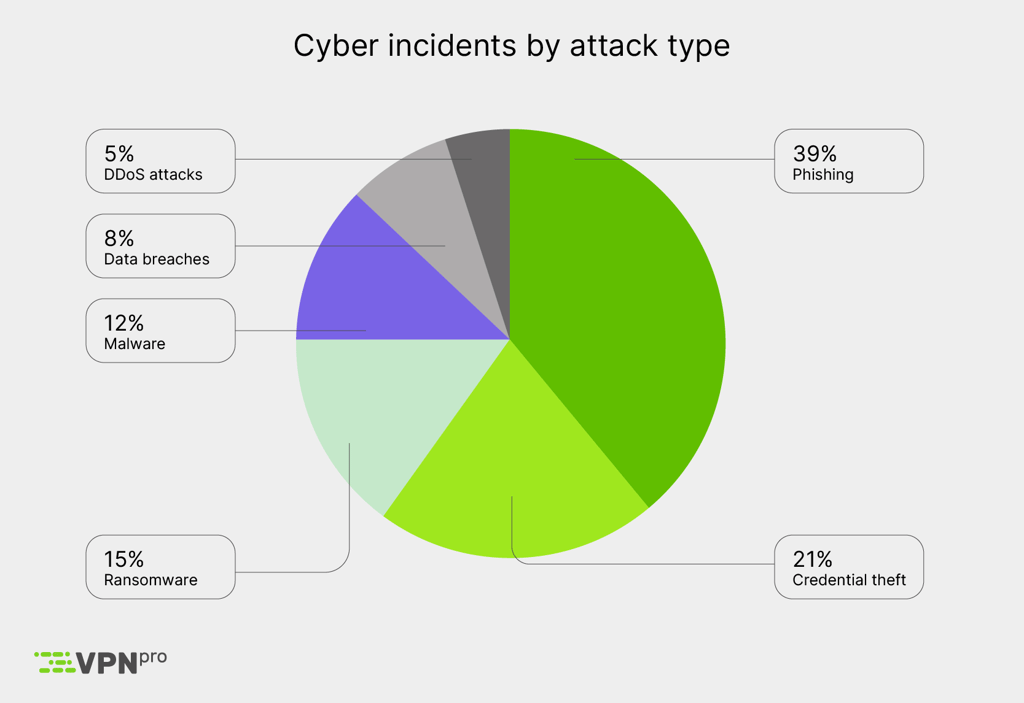
Security reports from organizations such as the World Economic Forum (WEF) and the Identity Theft Resource Center (ITRC) show that most cyber incidents start with simple methods like phishing or stolen login credentials. These attacks do not always require advanced hacking skills. Instead, attackers often rely on human mistakes or weak passwords to gain access to systems. Once inside a network, cybercriminals may install malware, steal data, or deploy ransomware to demand payment from the victim. Here are the most common cyberattacks:
1. Phishing
Phishing remains the most frequent attack type for a simple reason: it is the easiest way to bypass multi-million dollar security systems. In 2026, "Agentic Phishing" - where AI agents engage in real-time, convincing text conversations with victims - is expected to make up 42% of all global breaches. Because AI has removed the typical red flags like poor grammar, phishing has become a numbers game that hackers are winning through sheer volume.
🔗NordVPN introduces a new AI-powered solution to stop the rise of phishing attacks
2. Credential Theft
The biggest shift in the 2026 landscape is the move from "breaking in" to "logging in." Credential theft is now a primary entry point for 22% of incidents. Attackers are using specialized "infostealer" malware to snatch login details and session cookies. Once they have these, they can impersonate a user so perfectly that security systems don't even realize a crime is happening.
🔗Use NordPass to protect yourself from credential theft
3. Ransomware’s
While ransomware may happen less frequently than phishing, its financial impact is disproportionately massive. The WEF Global Cybersecurity Outlook 2026 forecasts that ransomware damages will reach $74 billion this year. The trend has shifted from simply "locking files" to "pure extortion" - where hackers steal sensitive data and threaten to leak it publicly unless a ransom is paid, a tactic that bypasses many traditional backup systems.
🔗Use TotalAV to prevent ransomware attacks
4. Malware
While phishing is the "trick" that gets a hacker in the door, malware (12%) is the tool they leave behind to do the dirty work. In 2026, we have seen a surge in "Wiper" malware - malicious programs designed not just to steal data, but to permanently delete it, paralyzing businesses and government services.
Even more common are "Infostealers," which sit quietly on your device, recording every keystroke and capturing your saved passwords. This is why having a modern antivirus is non-negotiable; it acts as an active immune system, recognizing the behavior of these malicious files and stopping them before they can transmit your private life to a remote server.
🔗Learn how to remove malware from your phone
🔗Check out the best budget antivirus for PC
5. Data breaches
A data breach (8%) is often the final result of the other attacks we’ve mentioned. It occurs when sensitive information - like your Social Security number, medical records, or private emails - is intentionally or accidentally exposed. In 2026, many of these breaches are actually "non-malicious," caused by simple human errors or misconfigured cloud settings.
The danger of a breach is that once your data is out there, it stays out there. Hackers use this "harvested" data to build synthetic identities or launch more convincing phishing attacks years later. Using a VPN helps reduce this risk by encrypting your internet traffic, making it much harder for hackers to intercept your data in the first place, especially when you are using public Wi-Fi at a cafe or airport.
🔗 Secure your accounts and prevent breaches with NordVPN
6. DDoS
Distributed Denial of Service (DDoS) attacks are often seen as just a way to take a website offline. However, in 2026, they are frequently used as a distraction. By launching an average of 44,000 DDoS attacks daily, cybercriminals "flood the zone," forcing security teams to focus on the website crash while the hackers quietly slip through the back door to steal data.
🔗 Find the top VPN for DDoS attack prevention
The economic weight of a breach: Why data theft is getting more expensive
If a data breach were a car accident, the stolen data would just be a broken bumper. The real expense comes from hospital bills, lawsuits, and the time you can’t spend at work. In 2026, we are seeing a Great Decoupling: while global costs are finally starting to stabilize, the cost of a breach in the United States has surged past $10 million for the first time.
Over the past few years, the price of a single incident has steadily climbed. These are the industries that are hardest hit by global average breach costs compared to the US breach costs:
| Year | Global average breach costs | US average breach cost |
| 2022 | $4.35 million | $9.44 million |
| 2023 | $4.45 million | $9.48 million |
| 2024 | $4.88 million | $9.36 million |
| 2025 | $4.44 million | $10.22 million |
| 2026 (forecast) | $4.88 Million | $10.50 Million+ |
*Sources: IBM Security “Cost of a Data Breach Report 2025,” SentinelOne 2026 Economic Forecast.
Even though 2025 shows a slight dip, the overall trend remains high. Costs are stabilizing at record levels rather than declining, which signals that cyber risks are becoming a permanent financial burden rather than a temporary spike.
Cost of breaches by region
Not all breaches are billed equally. Where a company operates, the price tag changes dramatically due to local laws and lawyers' costs in that region. Below, you can see how breach costs vary across different regions and what factors drive those differences:
- United States: $10.22 million is the world record for regulatory fines.
- Middle East: $7.29 million, largely driven by high-value energy and critical infrastructure targets.
- European Union: $5.20 million, stabilized by strict GDPR compliance but rising due to new AI regulations.
- Asia-Pacific: $3.60 million, rising fastest as digital infrastructure expands rapidly.
The large difference in breach costs across regions comes from a mix of legal, operational, and economic factors that change from country to country. In places like the United States and the European Union, strict regulations have a big impact. If companies fail to protect data, they face quick and costly legal consequences. By 2025, almost half of all regulatory fines were over $100,000, making compliance and legal defense a major part of the recovery budget.
The financial burden grows even more because detecting and handling breaches is expensive. In areas where labor costs are high, companies must hire specialized forensic experts and legal teams, often for about 277 days, which adds a big overhead that lower-cost regions avoid. These extra costs are often called a 'cyber tax,' since businesses in expensive regions end up raising prices to cover their losses. Research shows that 63% of organizations worldwide now admit to passing the cost of security failures directly to consumers.
Cost of breaches by industry
Every year, healthcare remains the most expensive sector. Because medical data is extremely sensitive, highly regulated, and critical to operations, downtime can literally affect lives. Below, you’ll see a table showing how data breach costs vary by industry:
| Industry | Average breach cost |
| Healthcare | $12.6 million |
| Financial services | $6.4 million |
| Technology | $4.8 million |
| Retail | $3.5 million |
In 2026, a data breach isn’t just a one-time fee, it’s a financial chain reaction that can haunt a company for years. The first big cost is operational downtime, since it now takes an average of 277 days to find and fix a breach. Every hour that systems are down means lost revenue. After that, companies often face regulatory penalties. In 2025, 32% of organizations received official fines, with many paying over $100,000 for each incident.
However, the biggest damage is often the loss of the customer trust. Recent research shows that 80% of consumers will stop supporting a brand after a breach. This shows that losing your reputation can cost much more than any ransom.
The good news is that acting quickly can lower the costs. Companies using AI-powered automation to spot threats faster are saving an average of $1.9 million compared to those relying on manual methods. For everyday users, having several layers of protection is key. Using antivirus software, like TotalAV, to block harmful files and a VPN such as NordVPN to protect your internet traffic are important first steps. These tools help you avoid the costly problems that can result from identity theft.
Cyber incidents by industry: Which industries face the most risk?
In 2026, cybercriminals have moved away from random attacks. Instead, they act like business analysts, targeting sectors where they have the most leverage. However, not all industries face cyber threats in the same way. Some sectors are targeted more often, not just because of their size, but because of the type of data they handle and how valuable that data is to attackers. Below, you’ll see how cyber incidents are distributed across industries:
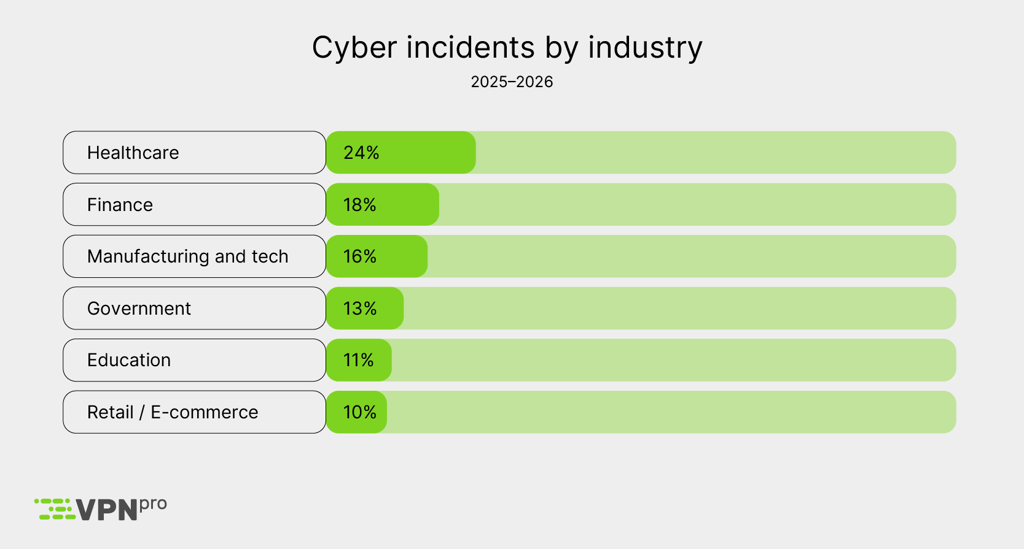
According to the latest cybersecurity forecasts for 2026, there is a major divide in how industries are affected. While a breach in a retail store might expose your shopping habits, a breach in the healthcare or government sector can paralyze the essential services we rely on every day.
Healthcare is the absolute top target for 2026, accounting for 24% of all forecast incidents. This industry is highly regulated, critical to daily operations, and stores some of the most sensitive personal data. For example, if a hospital goes offline due to a ransomware attack, the pressure to restore systems is immense, often leading to rapid payments that only encourage further attacks. As a result, stolen medical records are extremely valuable on the dark web because they cannot be easily changed like a credit card number.
Moreover, financial institutions are closely followed, making up 18% of incidents. Hackers in 2026 no longer focus on breaking in, but simply on logging in. Nearly 78% of finance attacks are driven by credential theft. Hackers use AI to steal login credentials from consumers like you to bypass advanced bank security measures.
For the manufacturing and technology sector (16% of incidents), the target is often operational uptime. The biggest risk is that every hour an assembly line stops costing millions. Criminals know this and use wiper malware or ransomware to paralyze factory floors.
Schools and universities (11% of incidents) are also a primary target because they store vast amounts of clean student data that can be used for identity theft for decades. According to the Center for Internet Security, 82% of K-12 schools have recently reported cyber incidents. In 2026, the risk compounds as schools struggle with third-party risk, where a single breach of an educational software provider can expose millions of students at once.
However, in the retail sector (10% of incidents), the battle is moving toward automation. In 2026, retailers are fighting off AI-powered bad bots, which now account for nearly 33% of all web traffic during peak shopping seasons. Recent reports indicate that these automated attacks are no longer limited to targeting credit card numbers. Instead, they focus on account takeovers and stealing personal credentials, which are often easier to exploit and sell on the dark web.
Governments (13% of incidents) face a unique, high-stakes threat where the motive is often espionage or disruption rather than just money. According to the 2025 Verizon Data Breach Investigations Report (DBIR), ransomware remains the most persistent threat here, appearing in 30% of all government breaches. These attacks often target local governments and public infrastructure, where a single successful hit can paralyze essential city services or leak sensitive data of every resident.
Largest cyber incidents in recent years
To understand the true scale of modern cyber threats, we have to look at individual events that redefine what risk means. According to the CSIS Significant Cyber Incidents database and recent 2024–2025 reports, we have entered an era where a single breach can paralyze an entire nation’s infrastructure or expose millions of private lives in a matter of hours. They are case studies in how vulnerabilities in the digital supply chain can trigger a financial and social domino effect. Below are the most impactful incidents from the last two years that have set the stage for 2026 risks:
| Organization | Year | Type | Impact |
| UnitedHealth | 2024 | Ransomware | 192M+ individuals impacted; $2.4B recovery cost |
| AT&T | 2024 | Cloud data theft | 176M records leaked; call/text metadata exposed |
| Ticketmaster | 2024 | Data Breach | 560M customers' sensitive data stolen |
| National Defense Corp (NDC) | 2025 | Ransomware | 4.2TB of sensitive data exfiltrated and leaked |
| Marks and Spencer Group | 2025 | Data Breach | 16.9M customers affected; $27M in costs |
*Sources: CSIS Significant Cyber Incidents Database (2024-2026), IBM Cost of a Data Breach Report 2025, and ITRC Breach Analysis.
The sheer scale of the UnitedHealth (Change Healthcare) attack in early 2024 changed the cybersecurity conversation forever. This wasn't just about stolen data; it was a systemic failure that led to nearly 94% of US hospitals facing financial repercussions. The attackers gained entry through stolen credentials on a server that lacked multi-factor authentication (MFA). This single oversight allowed them to exfiltrate 6TB of sensitive data, effectively holding the entire US healthcare payment system hostage and proving that their security is only as strong as your weakest link.
Similarly, the AT&T and Ticketmaster breaches of 2024 and 2025 highlighted a massive shift toward cloud supply chain attacks. In these cases, hackers didn't attack the companies directly; they targeted the third-party cloud platforms where the data was stored. For AT&T, this meant the metadata of nearly every customer was exposed, creating a gold mine for future AI-driven phishing attacks. By 2025, these incidents became more surgical. The National Defense Corporation breach showed that even highly secure military contractors are vulnerable to Agentic AI, which can autonomously navigate complex networks to find and leak terabytes of data.
Root causes of cyber incidents: Why breaches happen in the first place
Despite billions spent on high-tech defenses, the most common way hackers get in is by exploiting human behavior, according to the latest 2026 data. My analysis of current trends shows that the human element remains the undisputed champion of cyber risk, contributing to up to 95% of successful breaches. Here are the primary root causes driving today’s record-breaking incident rates:
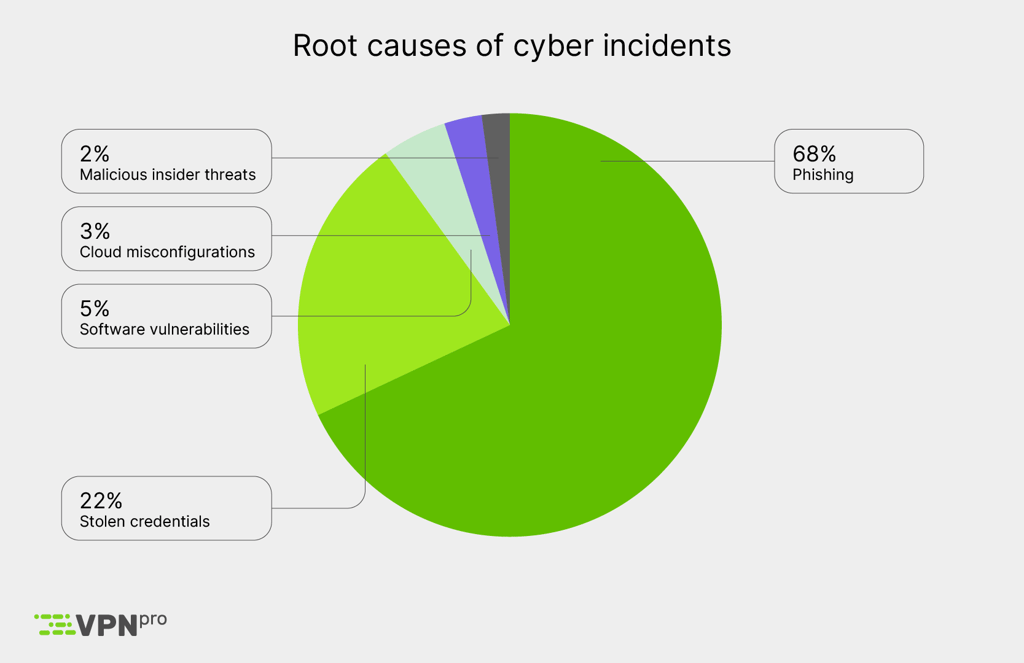
Phishing accounts for 68% of attacks and remains the most common way hackers get in. In 2026, there is a new wave of agentic phishing, where AI-generated messages no longer have obvious signs like bad grammar or spelling mistakes. These attacks are now four times as successful as they were two years ago because they can perfectly mimic the tone of a boss or a trusted brand.
Moreover, stolen credentials account for 22% of attacks and are still the foundation of most modern hacks. Attackers do not need to break in if they already have the key. According to the 2025 Verizon DBIR, nearly a quarter of all breaches involve credential abuse, often because people reuse the same password for different accounts.
However, software vulnerabilities account for 5% of attacks, but so-called zero-day exploits are particularly dangerous. A new vulnerability is found every 17 minutes, and hackers now use automated AI tools to find and use these weaknesses before companies are even aware of them.
Additionally, cloud misconfigurations account for 3% of attacks. As more companies move to the cloud, this silent problem continues. Right now, 95% of cloud security failures are caused by human error, such as accidentally leaving a sensitive database public, rather than problems with the cloud platform itself.
Nonetheless, malicious insider threats make up 2% of attacks. While these are rare, they are the most expensive to fix. They occur when employees or contractors intentionally steal data for money or personal reasons, often bypassing security controls because they already have access.
Overall, even if you accidentally click a perfect AI-generated phishing link, having antivirus software active can act as your digital safety net, blocking malicious files or infostealers before they harvest your data. Additionally, using a reliable VPN is your best defense against the Credential Crisis. By encrypting your internet traffic, a VPN ensures that your passwords and login tokens are hidden from hackers lurking on public networks, effectively cutting off the primary source of stolen credentials.
Cyber incident predictions for 2026: What’s coming next
As we look towards 2026, the digital battlefield has fundamentally changed. According to the World Economic Forum’s Global Cybersecurity Outlook 2026, we have reached a critical tipping point: 94% of security leaders now agree that AI is the single most significant driver of change in the year ahead. We are no longer just fighting human hackers; we are up against autonomous agents and machine-driven campaigns that can identify and exploit a vulnerability before a human defender even receives an alert.
In 2026, cybercrime has officially industrialized, moving from simple data theft to what experts call metamorphic malware, code that changes its own structure to remain invisible. Here’s a cybersecurity trend forecast of 2026:
| Trend | 2026 impact level | Key prediction for the year |
| AI-driven fraud | Critical | 73% of people will be directly targeted by AI-enabled fraud or phishing. |
| Supply chain attacks | High | Third-party compromises have quadrupled since 2020, targeting software connectors. |
| Agentic ransomware | Extreme | Ransomware will strike a business or consumer every 2 seconds by the end of the decade. |
| Infrastructure siege | Critical | 64% of organizations now prioritize "Geopolitical" attacks on power and water systems. |
The most significant shift in 2026 is the rise of agentic AI, malware that doesn't need a human to steer it. According to Experian’s 2026 Forecast, we are entering an era of machine-to-machine mayhem, where AI bots negotiate with other AI systems to bypass security. This has led to a surge in synthetic identities, in which hackers use stolen data to create fake people that look and act so real they can pass even advanced biometric checks.
We are also witnessing the poisoning of the supply chain for AI itself. As companies rush to integrate AI into their workflows, hackers target the underlying models. IBM’s X-Force 2026 Index highlights a 44% increase in attacks on public-facing applications, often driven by AI-enabled vulnerability discovery. This creates a silent door for attackers to slip through by exploiting basic security gaps that AI can now find in seconds.
Finally, the World Economic Forum warns of widening cyber inequity. While large enterprises spend billions on autonomous defense, small businesses and individuals are often left exposed. This makes personal defense more important than ever before.
Final thoughts: What does the data tell us about cyber risks in 2026?
The most undeniable trend is that cyber incidents continue to rise globally, with no sign of slowing down, as automated tools enable criminals to attack more people in less time. While methods are getting smarter, entry points remain surprisingly consistent: phishing and credential theft remain the dominant attack vectors, involved in nearly 64% of all successful breaches. Attackers aren't necessarily breaking through digital walls anymore; they are simply using stolen keys to walk through the front door.
Cybercrime costs continue to grow, with global losses projected to exceed $10.5 trillion this year. This is felt most acutely in the healthcare and financial sectors, which remain the top targets due to the extreme sensitivity and high resale value of the data they hold.
Luckily, staying safe in 2026 doesn't require you to be a technology expert. Foundational tools remain your best defense. For instance, having an antivirus like TotalAV installed on your device prevents malicious files from infecting it. Similarly, using a VPN such as NordVPN to encrypt your internet traffic keeps your credentials hidden from automated hackers that fuel today's credential-theft crisis.

![Surfshark weekly deals logo [IN USE]](https://media.vpnpro.com/surfshark-weekly-deals.svg)
![Proton VPN winner logo [IN USE]](https://media.vpnpro.com/2025/05/protonvpn-winner.png)


