Expert analysis: why do people use VPN?

Over the last decade, VPNs (virtual private networks) have become one of the most common cybersecurity tools globally. Although VPNs were created to secure corporate networks, they are now widely used by regular internet users to enhance privacy, bypass geo-restrictions and internet censorship, and secure online activities.
🏷️ LIMITED OFFER: NordVPN deal! Get 76% OFF NordVPN + 3 months FREE 🏷️
In this article, I’ll share realistic data on VPN adoption and usage trends, including how many people use VPNs globally and how often they use them for activities such as online gambling and streaming.
Global VPN usage statistics
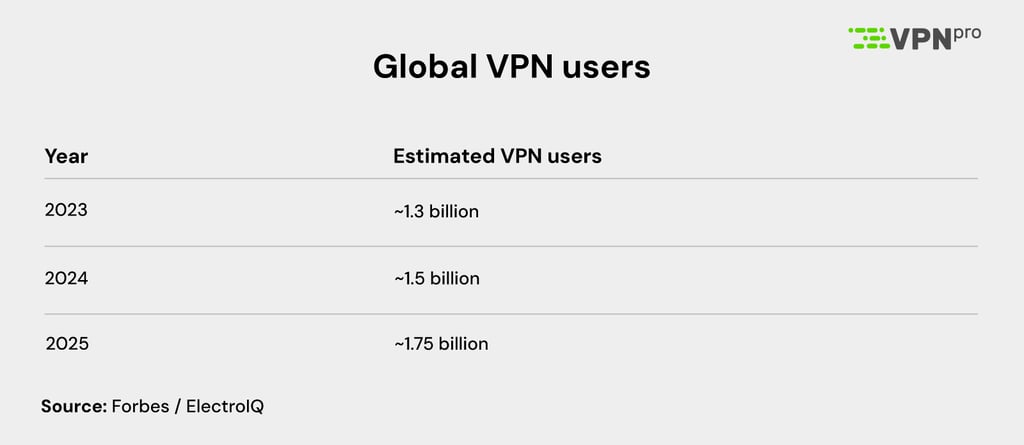
With a huge growth spurt in the last decade, VPN usage has now stabilized, with 1 out of 4 internet users relying on VPNs for various purposes, including security and accessing blocked content. Here are some quick facts:
- 23.1% of global internet users aged 16+ use a VPN as of 2024.
- That equals roughly 1.75 billion internet users in 2025.
- Some industry estimates suggest VPN users represent about one-third of all internet users globally.
- In the United States, 32% of adults reported using a VPN in 2025.
This progression clearly shows that VPN services are no longer niche products for corporate network protection. Instead, they have become everyday consumer tools used by nearly a quarter of all internet users worldwide.
Why people use VPNs
As intended by VPN developers, the technology is still primarily used for security, with up to 80% of VPN users citing this as the main reason for using it:
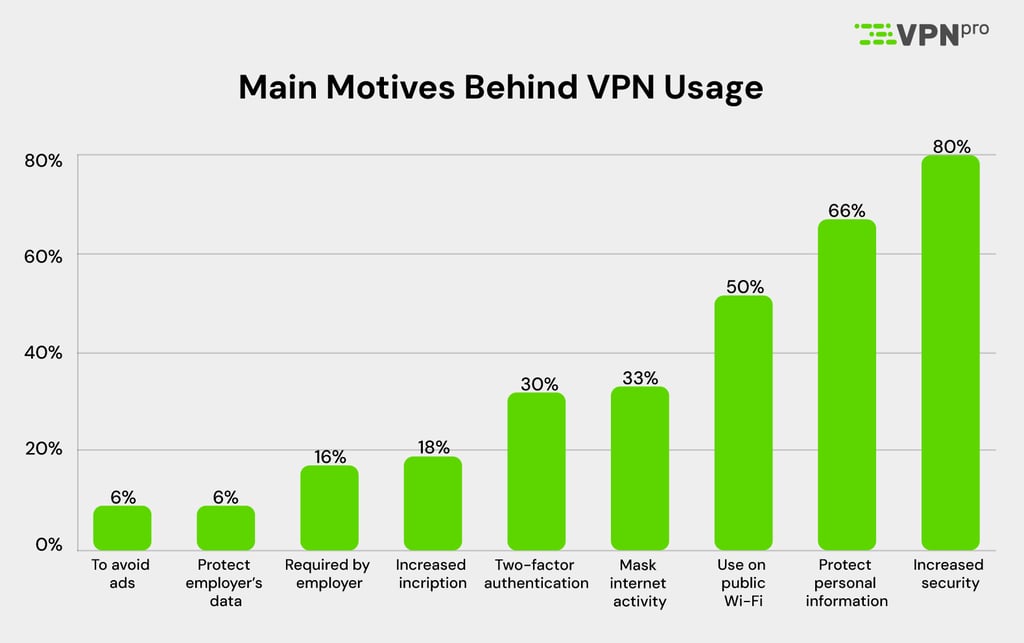
As you can see, around 80% of VPN users rely on VPNs for increased security, while another significant 66% use VPNs to protect personal information. Around 50% of VPN users are also aware of the dangers posed by unsecured public Wi-Fi connections and use virtual private networks to reduce those risks. Around 33% use VPNs to mask internet activity, and another 30% use the technology with two-factor authentication as a broader approach to online security. Lastly, the smallest groups favor VPNs for strong encryption, to comply with employer requirements, to protect the employer's data, and to avoid online ads. All in all, this data clearly shows the importance of VPNs as reliable online security tools.
However, as VPN usage grows in popularity, the reasons for using VPNs are also shifting from pure security to entertainment and accessing geo-locked content. For example, a 2025 survey documented that while 52% of US VPN users still mainly use the technology to mask their IP address, a not-far-off 35% use the tool to bypass website blocks:
| Reason for using a VPN (US users) | Percentage of users |
| Protect privacy | 52% |
| Bypass website blocks | 35% |
| Avoid government surveillance | 35% |
| Access restricted websites | 28% |
While there are many reasons why VPNs are becoming more than just a privacy tool, the recent implementation of ID verification to access certain websites in the US and Europe has significantly accelerated the shift.
VPN usage for streaming
Besides security and IP address masking, accessing and streaming geo-restricted content is one of the most common personal uses of VPN services. A Forbes survey found that around a third of VPN users access restricted content using VPN services.
The reason for this kind of use is that streaming platforms, such as Netflix, offer different libraries depending on your region, while others, such as BBC iPlayer and Hulu, are only available in specific countries.
Below, I gathered some key statistics on VPN use for streaming:
| Streaming-related VPN use | Percentage |
| Bypassing geo-restrictions on streaming platforms | 30% |
| Streaming sports or entertainment content | 33% |
| Accessing blocked sites or services | 35% |
VPN usage for online gambling
VPN use for online gambling is not as prevalent as it is for security and entertainment; however, it remains a notable use case. The UK Gambling Commission’s Consumer Voice conducted a survey of 1,007 respondents and found that:
- 5% of respondents said they always use a VPN when visiting gambling websites.
- 7% reported keeping a VPN permanently active on their device.
- 8% said they have a VPN but do not check whether it is active when gambling online.
- 18% have a VPN but never use it for gambling sites.
- 58% reported not having a VPN.
Yet, when it comes to using VPNs to access unlicensed gambling websites, VPN use triples, with 19% of respondents stating they always use a VPN when visiting such platforms.
| Online gambling-related activity | Percentage of VPN users |
| Access gambling or betting websites | 28% |
| Access blocked regional websites | 35% |
| Access unlicensed gambling websites | 19% |
What these trends mean for VPN usage
Looking at the results of various surveys, it's clear that VPNs are no longer niche products but everyday necessities for many internet users. With many citing security and the protection of personal information as their main motivations for using VPNs, the broader adoption of the technology also reflects growing awareness of cybersecurity threats. Because VPNs encrypt user data and route it through secure tunnels, they make it harder for internet providers, public Wi-Fi operators, advertisers, and other third parties to monitor browsing activity.
Looking ahead, the motivations to protect privacy and enhance online security are very likely to grow, especially as most everyday activities gradually move online. Banking, shopping, remote work, and entertainment have largely gone digital, and the trend continues to grow as global smartphone screen time rises. This, in turn, raises the user expectations for VPN companies to make their product fast, easy to use, and highly reliable.
Ultimately, this growing demand for VPN services is pushing providers to focus on performance and usability, with a focus on first-time users or VPNs becoming the one-stop shop for all online security needs. As VPNs are no longer IT specialist-only tools, regular users will continue to seek services that run seamlessly in the background as they go about their everyday online activities.

![Surfshark weekly deals logo [IN USE]](https://media.vpnpro.com/surfshark-weekly-deals.svg)
![Proton VPN winner logo [IN USE]](https://media.vpnpro.com/2025/05/protonvpn-winner.png)
Sources and methodology
To write this article, I relied on several well-respected sources, including Forbes, eMarketer, DataReportal, NDSS Symposium, UK Gambling Commission,and Demandstage, to gather relevant information and provide a fair overview of the current motivations behind VPN usage. None of the statistics in this article has been adjusted or otherwise changed.


Since 2018, VPNpro has delivered unbiased, expert-backed insights through in-house research and thorough VPN testing. Our team ensures every review is fact-checked and reliable. Learn how we maintain these high standards in our testing methods.


