
Porn age verification laws are driving VPN usage, 2026 VPNpro report

Short summary: Demand for adult content remains steady, even as new laws require users to verify their age to access these sites. Instead of uploading personal identification, many users choose VPNs to protect their privacy. As a result, VPN-related searches consistently spike immediately after enforcement begins, reflecting a clear shift in user behavior.
🏷️ LIMITED OFFER: Proton VPN deal! Get up to 70% OFF Proton VPN 🏷️
Users switch to VPNs instead of verifying identity on porn sites
Introducing age verification requirements forces users to make a choice: submit personal identification or leave the platform. However, the research suggests that many are unwilling to share sensitive information such as their IDs or personal details, primarily due to privacy and security concerns. According to the 2026 survey data, 79% of users express concern about how their data is handled, which directly influences their decision to avoid verification. The diagram below illustrates how users respond when age verification is required.
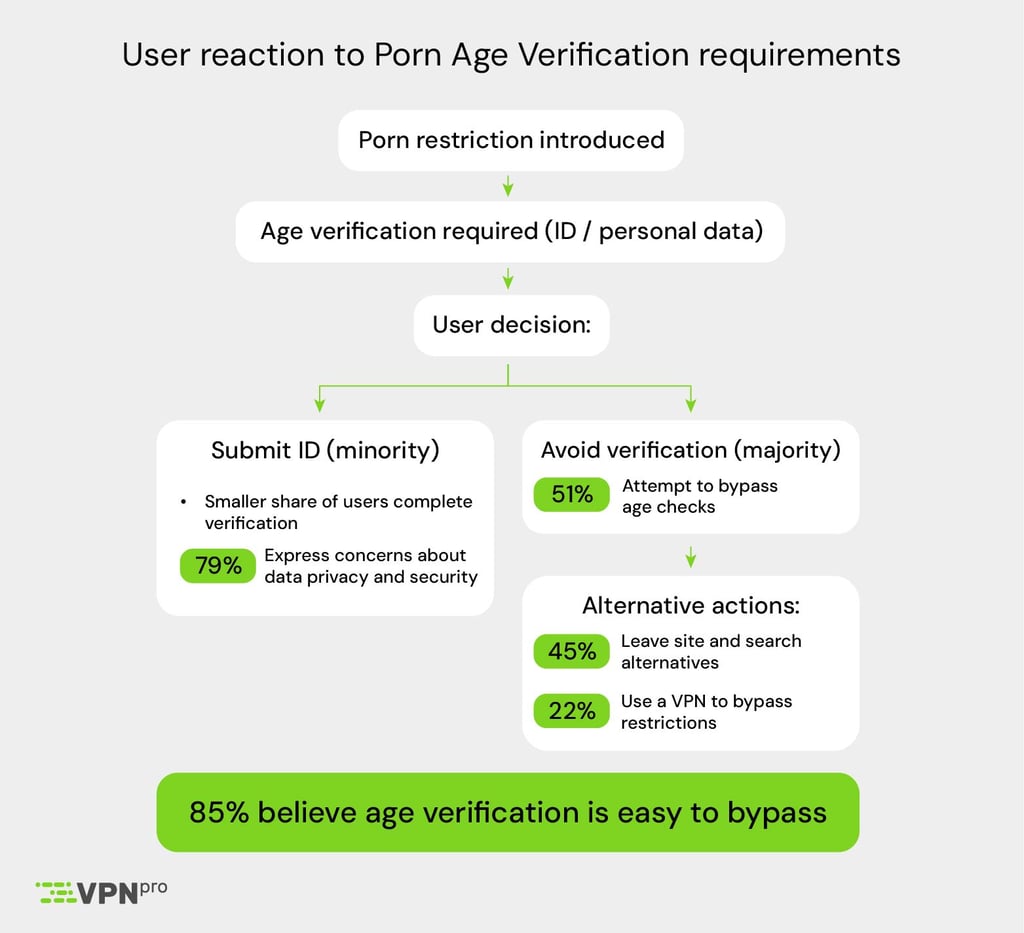
Many users choose alternative paths instead of completing verification. Around 51% attempt to bypass age checks, while others leave the site and look for different ways to access content. Among these alternative actions, 45% search for other platforms, and 22% turn to VPNs as a way to bypass restrictions while maintaining a level of privacy.
Overall, the data shows a consistent trend: when forced to choose, users favor privacy-preserving options. Rather than engaging with verification systems, they adapt by seeking alternative access methods, with VPNs becoming one of the most practical tools in this transition.
VPN usage increases immediately following the introduction of porn restrictions
There is a consistent behavioral pattern across multiple regions: VPN demand starts rising shortly after new porn access restrictions are announced and reaches its peak within days. There is a repeatable user response to access limitations and identity verification requirements across many countries, including the UK, Australia, Italy, France, and several US states.
In most observed cases, early signals appear within 1–3 days after announcement or initial rollout, as users anticipate upcoming restrictions and begin searching for alternatives. However, the most significant spike occurs on the enforcement date or within the following 24–48 hours, when access is directly restricted, or identity verification becomes mandatory. The chart below shows how VPN-related demand changes in Australia.
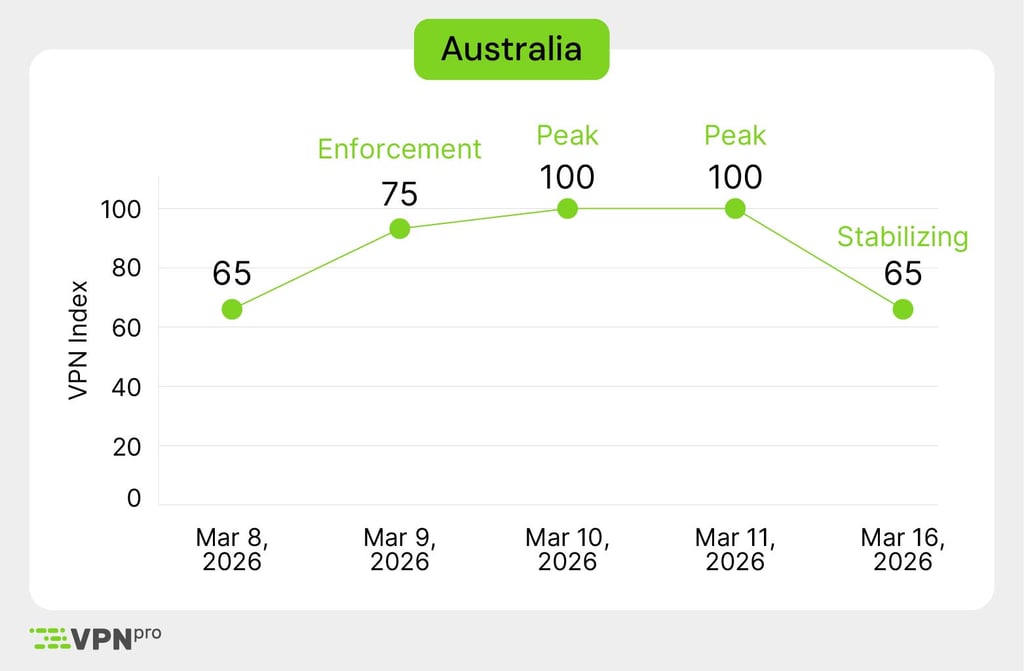
VPN interest rose from a baseline index of 65 on March 8, 2026, to 75 on March 9 after enforcement, before peaking at 100 on March 10–11. This indicates a sharp increase within 24 hours of enforcement, followed by stabilization within a week.
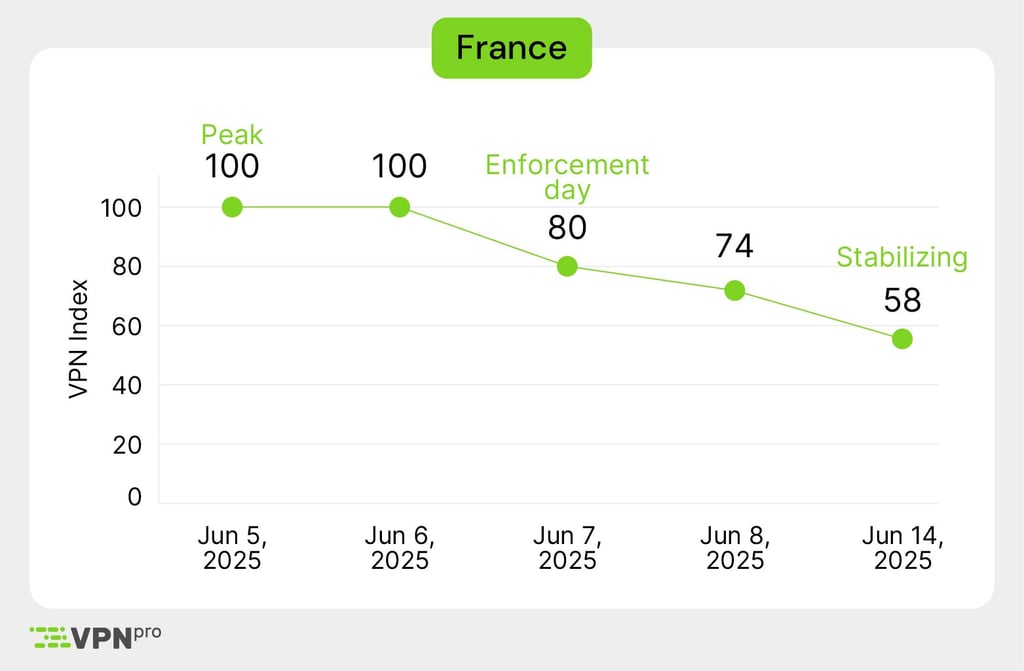
In France, demand peaked immediately at 100 on June 5–6, 2025, even before enforcement adjustments began. After enforcement on June 7, interest declined gradually to 58 by June 14, suggesting early anticipation followed by normalization.
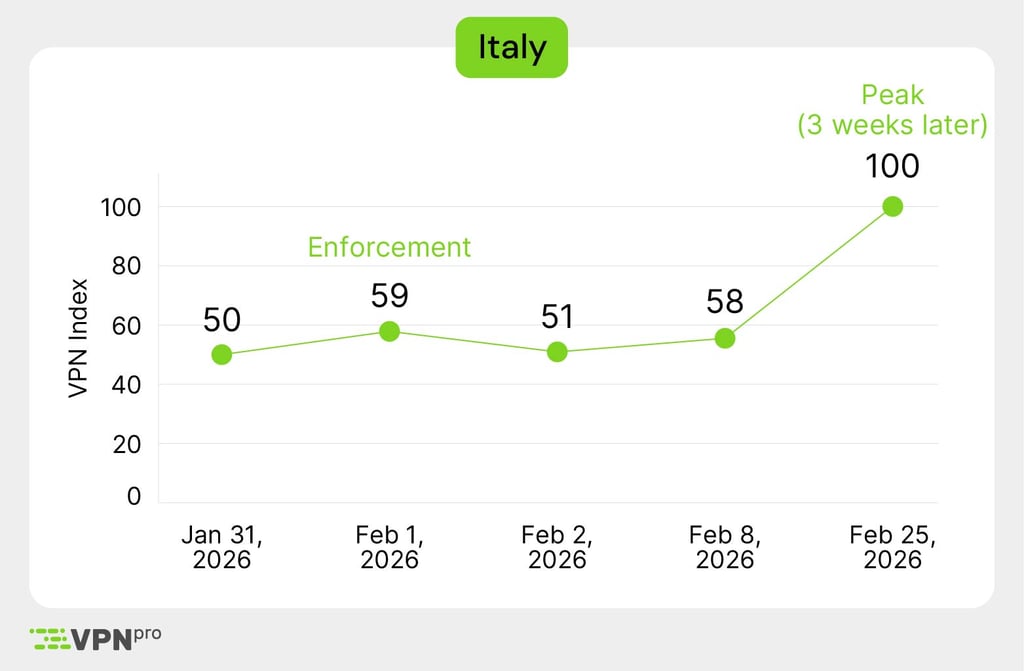
Italy shows a delayed response pattern. Around February 1, enforcement-related activity appeared (index 59), but the peak (100) occurred three weeks later (February 25). As a result, there is slower behavioral adaptation, yet ultimately the same outcome: a maximum demand after increased restrictions have been imposed.
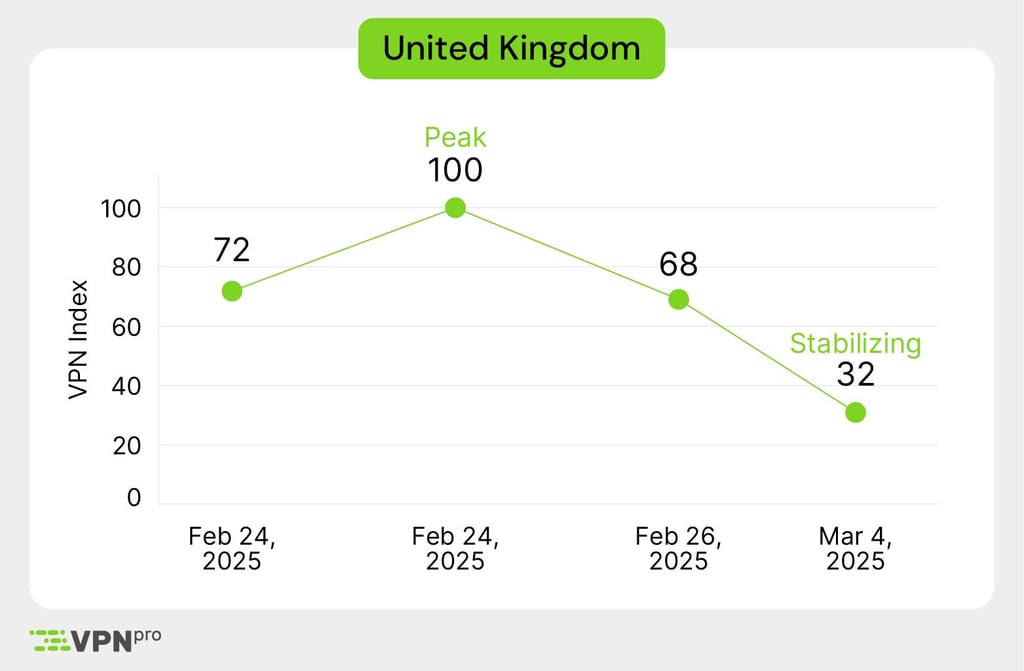
The UK's VPN demand jumped from 72 to 100 on February 24, 2025, when enforcement intensified, before declining to 32 by March 4. Approximately one week after this spike, the numbers began to stabilize.
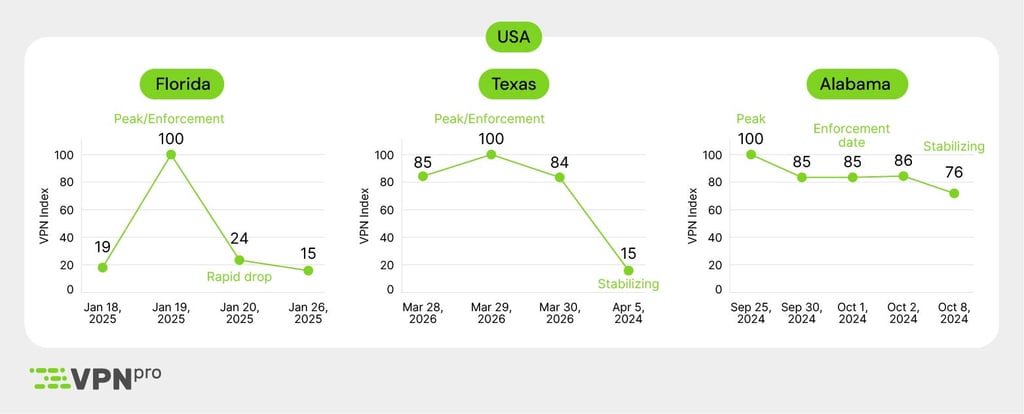
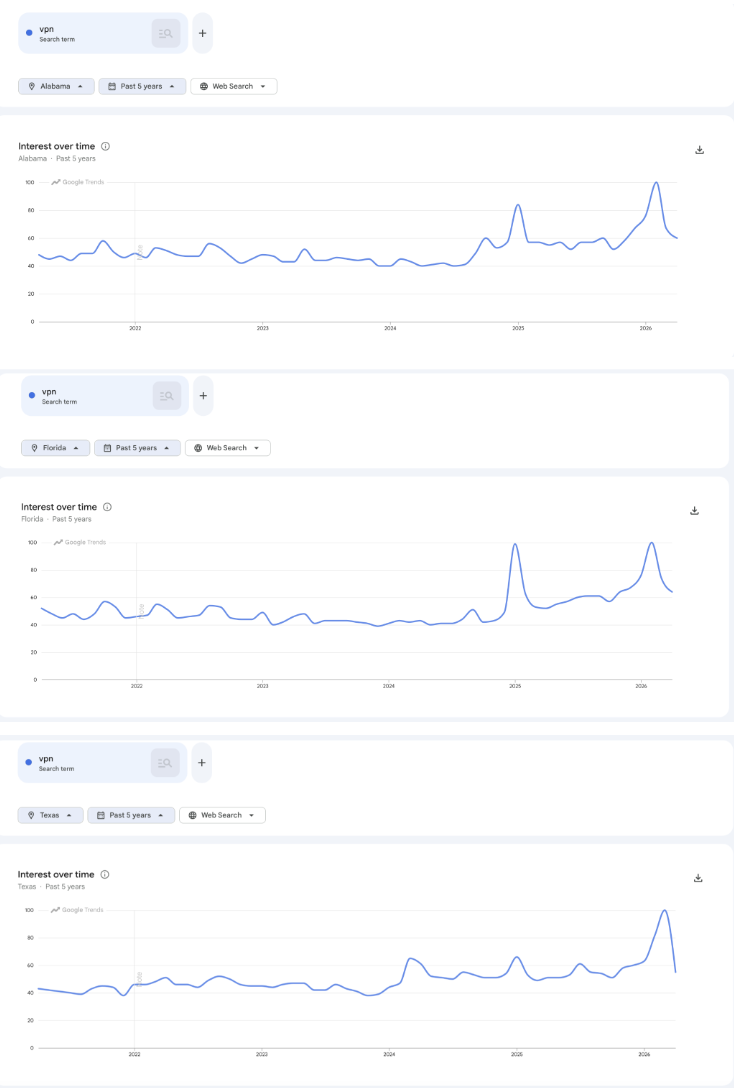
US state-level data shows similar but more fragmented patterns. In Florida, for example, VPN demand surged from 19 to 100 within one day (Jan 18–19, 2025), then dropped rapidly. Texas increased from 85 to 100 in enforcement (Mar 29, 2026), then declined rapidly. In Alabama, peak activity (100) occurred slightly before enforcement, with elevated levels (85–86) persisting for several days.
Across all regions, VPN demand typically increases after enforcement begins in 1–2 days, when users are directly confronted with access restrictions or identity verification requirements. This pattern reflects a clear cause-and-effect relationship: once users encounter blocked content or are required to submit personal data, VPN usage shifts from consideration to immediate action.
Increases in VPN usage are observed across multiple countries after new restrictions
VPN usage rises consistently across different regions following Porn Age Verification laws. While the scale of increase varies, the direction of change is the same: once access is restricted or identity verification is required, users look for alternative ways to access content. This pattern is measurable across the US (state-level), the UK, Australia, Italy, and France, indicating that the response is not isolated but systemic. The chart below compares estimated increases in VPN-related demand following the introduction of porn access restrictions across selected countries.
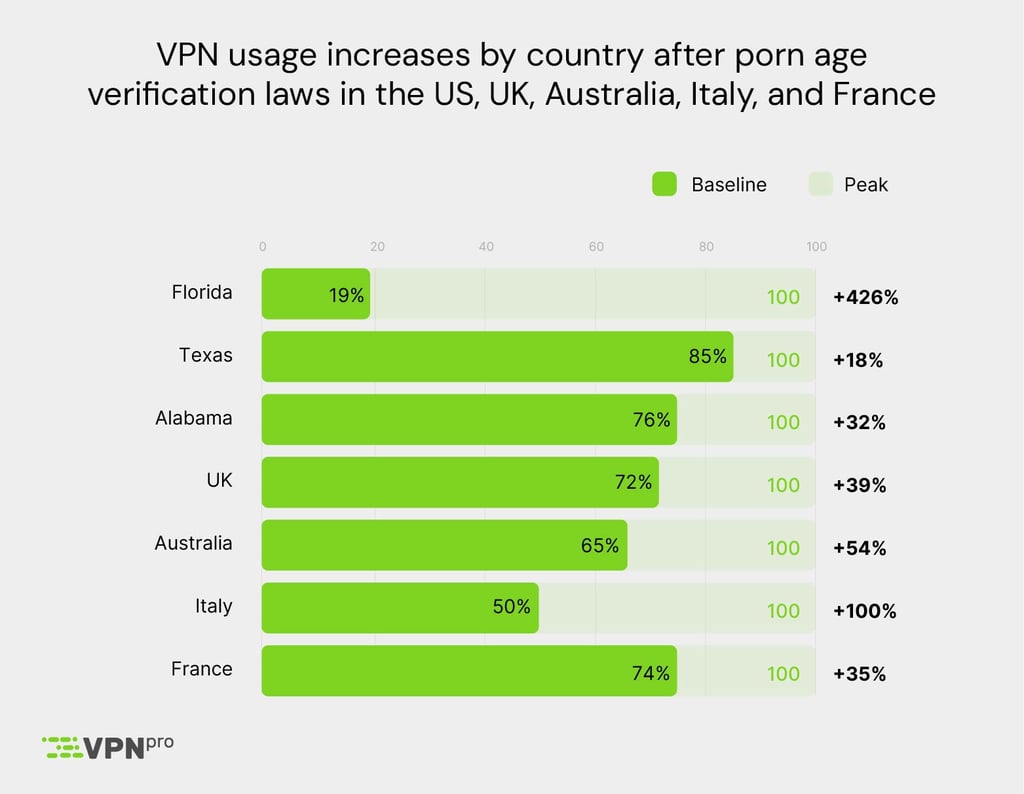
The highest increases are observed in countries where enforcement is immediate, and access is directly restricted. Countries with stricter or more immediate enforcement tend to see stronger spikes, while regions with higher baseline awareness show more moderate growth. For example, in US states like Florida, VPN demand surged by over +400% following enforcement, while countries like Italy (+100%) and Australia (+54%) still show clear and significant increases. Even in more mature markets such as the UK (+39%) and France (+35%), demand rises noticeably, reinforcing users' behavior across different environments.
US users turn to VPNs after PornHub blocks and state laws
Louisiana was the first US state to introduce mandatory age verification for online pornography, with Act 440 taking effect on January 1, 2023. Following this, other states, including Texas, Florida, and North Carolina, introduced similar measures, enforcing strict age verification requirements. The law requires users to verify their age with a government-issued ID or a digital ID app such as LA Wallet, which led to a notable drop in traffic to major adult platforms.
In response, platforms such as PornHub chose to block access in those US states rather than process sensitive user data, citing privacy and security concerns. After such regulation, VPN demand increased sharply, for example, VPN-related searches in Florida increased by over 400%. This indicates that users are not disengaging, but instead bypassing restrictions with reliable VPNs to maintain access without sharing personal identity data.
UK users adopt VPNs after mandatory age verification rules
The UK implemented mandatory age verification on February 2nd, 2026, requiring users to prove their age before accessing adult content, usually through ID, facial scans, or payment data. Platforms like PornHub, RedTube, YouPorn, Brazzers, and Tube8 withdrew access in the UK rather than fully comply, citing privacy concerns. Other platforms, including xHamster, SpankBang, and XNXX, require users to verify their age before entering.
Following enforcement, VPN usage increased sharply. Industry data shows that VPN signups rose by up to 1,400% within hours of the rules taking effect, with VPN apps quickly dominating UK app store rankings. This indicates that users did not disengage but instead shifted to VPNs to bypass verification requirements, avoiding the need to submit sensitive personal data.
Australian users increasingly rely on VPNs amid regulatory pressure
Australia introduced stricter online safety rules in March 2026, requiring platforms to implement age verification for accessing adult content. In response, major providers, including PornHub and other sites owned by Aylo, blocked access for Australian users rather than collecting sensitive identity data. This created an immediate access barrier, similar to what is observed in other regulated markets following porn bans.
According to the research, VPN app downloads surged and climbed to top positions in app store rankings, with some services jumping dozens of positions within days. Additional reports indicate that VPN downloads nearly tripled around the enforcement date, reflecting a direct response to blocked access. As a result, users increasingly rely on VPNs rather than identity verification to access the internet without exposing their personal information.
Users in Italy and France shift to VPNs under stricter enforcement
Italy introduced mandatory age verification requirements in November 2025 under AGCOM regulations, requiring users to prove they are over 18 before accessing explicit content. A similar pattern is observed in France in June 2025, where strict enforcement has led major platforms such as PornHub to block access entirely rather than implement intrusive verification systems, citing privacy concerns. In both countries, VPN usage increased as users sought to bypass age verification requirements.
This VPN usage response highlights a clear gap between regulatory intent and user behavior, with privacy concerns driving immediate adaptation. In practice, stricter enforcement does not eliminate VPN demand; it redirects users toward VPNs as a practical, privacy-preserving workaround.
Users increasingly rely on alternative access methods instead of verification
Users tend to choose alternative access methods when age verification requirements are introduced, rather than submit personal identification. Research shows that many prefer to leave platforms rather than complete verification, reflecting concerns around privacy and data security.
This behavior is visible in search activity, where users begin looking for ways to bypass restrictions, including alternative or mirror websites that do not require verification. These patterns typically emerge shortly after announcements and intensify with enforcement.
At the same time, workaround behavior becomes more structured, with users moving from temporary solutions (such as switching sites) to more reliable tools. Among these, VPN use is the most consistent, allowing users to bypass geographical restrictions and access content without revealing their identity. As a result, VPN adoption increases at the point of enforcement and continues to grow beyond the initial spike.
Initial reliance on free VPN services is followed by a shift toward paid solutions
Typically, users start with free VPN services when access restrictions are introduced because they are easy to access and cost nothing up front. These tools serve as an immediate solution, especially during the initial spike in demand following enforcement. However, real usage patterns show that free VPNs often fail to meet ongoing needs. Common limitations include:
- Reduced speeds and unstable connections
- Data caps that restrict prolonged use
- Limited server availability
- Weaker privacy guarantees, including potential user activity logging
As users continue to rely on VPNs for regular access, these constraints become more apparent. Over time, regular VPN usage leads to a gradual transition toward paid VPN services, which offer more consistent performance, broader server coverage, and clearer privacy policies. It represents a shift from temporary workarounds to sustained usage, where data security and reliability become equally important.
Privacy risks drive VPN use when porn sites require identity verification
Age verification systems fundamentally change how users interact with adult platforms by introducing identity checks that require sensitive personal data, such as government-issued IDs or biometric confirmation. While these systems aim to enforce compliance, they also introduce perceived privacy risks that directly influence user behavior. Research indicates that concerns about data exposure, tracking, and the storage of personal information are key drivers of avoidance of verification systems. The chart below indicates why users avoid porn age verification.
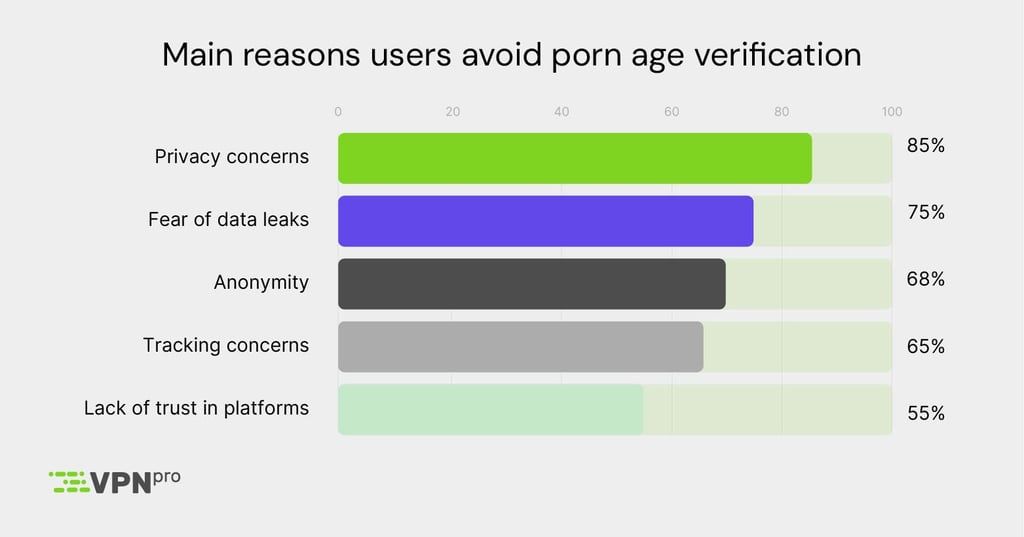
The findings highlight that privacy concerns are the dominant factor, cited by 85% of users, followed by fear of data leaks (75%) and the desire to remain anonymous (68%). Moreover, concerns about tracking (65%) and a lack of trust in platforms (55%) contribute to this behavior pattern.
From a cybersecurity perspective, age verification shifts the perception of risk from content access to data exposure. Users are no longer evaluating whether to access content, but whether the cost of access includes surrendering sensitive identity information. As a result, verification becomes a privacy trade-off rather than a simple compliance step. Moreover, users prioritize anonymity and data protection over platform access. Lastly, VPNs emerge as a practical workaround, enabling access without identity disclosure.
Restrictions are associated with increased VPN use rather than reduced access
Age verification laws do not lower the demand for adult content, but they do change how people access it. In the UK, after these measures were put in place, PornHub saw a 77% drop in local traffic. This shows that many users chose not to verify their identity, but it does not mean they stopped looking for content. Instead, it points to a change in how people get access, not a drop in interest.
In reality, people adapt quickly; rather than following verification rules, they switch to other platforms, use VPNs, or find other ways to circumvent the restrictions. This pattern shows a clear cause-and-effect relationship. When access is blocked, people respond by using tools to get around the rules. In this case, using VPNs is not random; it is a direct response to these restrictions.
VPN usage follows a consistent pattern before and after regulatory changes
VPN usage around age verification laws follows a clear, repeatable pattern rather than changing randomly. Before any restrictions are introduced, VPN demand remains stable, reflecting typical usage levels. However, once new regulations are announced, early signals begin to appear. Search behavior indicates that interest in VPNs begins to rise even before enforcement, driven by public awareness and anticipation of restrictions, with further spikes observed once the laws take effect.
The most significant change occurs at the point of enforcement. Evidence from recent regulatory rollouts shows that VPN demand rises quickly, often within the first 24–48 hours, as users respond to blocked access or verification requirements. For example, when age verification laws were introduced in Australia, VPN apps surged in download rankings as major adult platforms restricted access, reflecting a rapid shift in user behavior.
After this initial spike, demand stabilizes but does not return to previous levels. Instead, VPN usage settles at a higher baseline, suggesting that users will continue relying on these tools even after adapting to the new restrictions. This pattern has been observed across multiple countries, reinforcing the link between regulatory changes and sustained shifts in how users access content.
Methodology and data sources
This analysis is based on publicly available search demand data and comparative trend evaluation across multiple regions where age verification measures have been introduced. The screenshots below illustrate VPN-related searches in Google Trends in the US states (Alabama, Florida, Texas), between 2023 and 2026.
The following are countries such as England, Australia, France, and Italy.
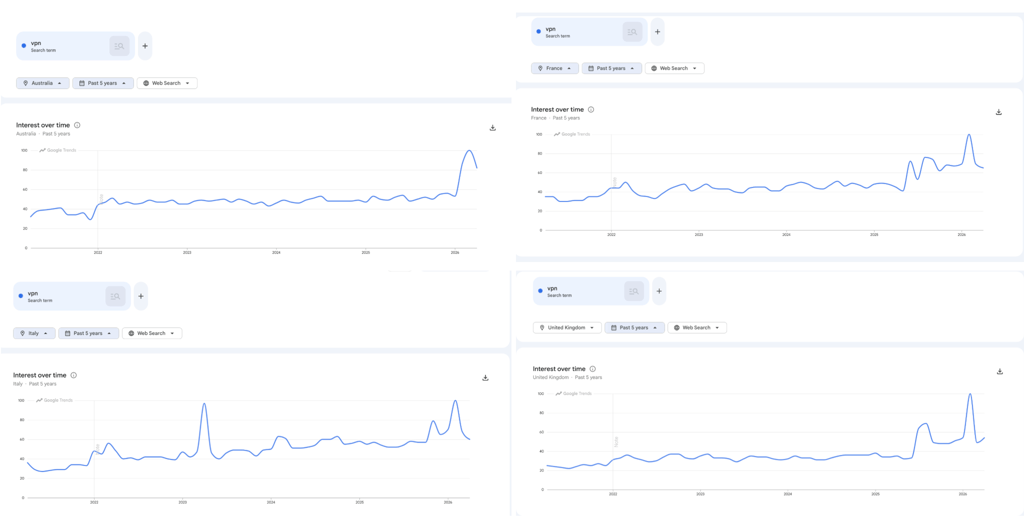
Across all analyzed regions, VPN-related search interest remains stable before restrictions and rises sharply around enforcement, with the strongest spikes occurring when users are directly confronted with blocked access or identity verification requirements.
The pattern is consistent across countries, suggesting that access disruption drives user behavior rather than policy awareness alone. In practical terms, users do not significantly change their behavior when regulations are announced, but react immediately once restrictions are enforced.
Implications for users and online privacy
In environments where age verification is enforced, user behavior reveals a clear priority to maintain privacy. Rather than submitting personal identification, many users choose to avoid verification altogether, reflecting broader concerns about how sensitive data is handled and protected online.
As a result, VPNs are no longer seen as optional tools but as a default solution for maintaining both access and privacy. Instead of engaging in verification processes, users rely on VPN services to bypass restrictions while avoiding the need to disclose personal information. This shift reflects a growing normalization of VPN usage as part of everyday online behavior in restricted environments.
At the same time, restrictions do not reduce demand for adult content. Instead, users adapt by changing how they access it, turning to alternative platforms, VPNs, or other workarounds. This suggests that regulatory measures primarily reshape user behavior rather than eliminating it, reinforcing the idea that users tend to prioritize access and privacy over compliance.
Overall, users adapt faster than regulations, and when faced with restrictions, privacy-driven tools like VPNs become the default way to maintain access.

- Users switch to VPNs instead of verifying identity on porn sites
- VPN usage increases immediately following the introduction of porn restrictions
- Increases in VPN usage are observed across multiple countries after new restrictions
- Privacy risks drive VPN use when porn sites require identity verification
- Restrictions are associated with increased VPN use rather than reduced access
- VPN usage follows a consistent pattern before and after regulatory changes
- Methodology and data sources
- Implications for users and online privacy